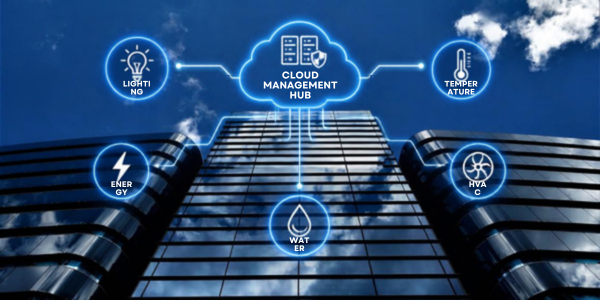
IoT building management is changing how building owners and facilities teams monitor, understand and control their buildings. Rather than replacing a Building Management System (BMS), IoT technology can turbo-charge its capabilities, bringing in more data, extending visibility across the building and giving teams a much clearer picture of how systems are performing.
That can mean spotting inefficiencies sooner, identifying developing problems earlier and making smarter decisions about energy use, comfort and building performance. For businesses considering smart building technology, the important question is not simply whether to adopt IoT. It is how to integrate it effectively, securely and commercially with the systems already in place.
What is IoT in building management?
To understand the opportunity, it helps to start with what IoT actually means in a building.
The Internet of Things, or IoT, describes connected sensors, meters, devices and systems that can collect and exchange data. Within a commercial building, this might include temperature and humidity sensors, energy meters, occupancy sensors, water monitoring devices or indoor air quality sensors.
That information can then be brought together with data from the existing BMS. Building operators gain a clearer picture of how the property is performing and where action may be required.
A traditional BMS already performs an important role by monitoring and controlling systems such as HVAC, lighting and other mechanical or electrical services. Smart building IoT adds another layer of information and connectivity, particularly where installing conventional wired sensors would be difficult or expensive.
This makes IoT particularly useful when modifying or upgrading an existing BMS.
How is IoT changing traditional building management systems?
Once additional data is available, a BMS can become a much more useful operational tool.
One of the biggest misconceptions around IoT building automation is that adopting IoT means replacing the existing control system. In many buildings, that would be unnecessary.
At Cube Controls, we have used wireless IoT products to augment existing and sometimes older BMS equipment. This can provide additional environmental or energy data without requiring major changes to the underlying control infrastructure.
Wireless technology can be especially valuable in occupied buildings. Running new cables through finished or continuously used spaces may be disruptive, impractical or disproportionately expensive. Wireless sensors can provide another route to gathering the information required.
For example, Cube Controls used wireless IoT technology at One The Strand to create a metering data and energy logging platform incorporating operational information from the existing BMS. The project demonstrates how IoT can enhance an established building management system rather than requiring it to be replaced.
This ability to connect old and new technologies is an increasingly important part of creating practical Building Management Systems.
What are the benefits of IoT in building management?
Better connectivity is useful, but the real value comes from what building teams can do with the information.
Improved energy efficiency
More detailed information can help identify where energy is being used unnecessarily. IoT for building energy efficiency might reveal plant operating outside required hours, spaces being heated or cooled unnecessarily, or differences between expected and actual consumption.
When this data is connected to the BMS, facilities teams have better information for optimising control strategies and reducing avoidable energy use.
Real-time building monitoring
IoT building monitoring can provide information from areas or assets that were previously difficult to monitor. Instead of relying solely on periodic manual checks, operators can see changing conditions and investigate unusual behaviour sooner.
Combined with a remote or cloud-based BMS interface, appropriate data can also be made accessible without requiring the facilities team to be permanently on site.
More proactive maintenance
Additional operational data can help teams recognise developing problems before they become more disruptive.
For example, if temperatures, plant operation or energy consumption begin moving away from normal patterns, those changes can prompt investigation. This gives maintenance teams better evidence when deciding whether equipment needs attention.
Improved occupant comfort
Environmental sensors can provide a more detailed picture of conditions across different spaces. Temperature, humidity and air quality information can help operators understand whether building services are delivering the environment occupants actually need.
The aim is not simply to collect more data. It is to use it to make better control decisions.
Reduced operational costs
Better information can support lower operating costs by reducing unnecessary consumption, identifying faults earlier and helping teams focus maintenance where it is required.
The potential benefit depends on the building, its existing systems and how effectively the information is used. An IoT platform on its own does not create savings; the control strategy and ongoing management remain critical.
How is IoT being used in smart buildings?
Those benefits become clearer when applied to everyday building operations.
HVAC and temperature control
Wireless sensors can add temperature and environmental monitoring in areas not adequately covered by an existing installation. Data can then inform HVAC control and help operators investigate comfort complaints or inefficient operation.
Energy monitoring and smart metering
Connected meters can provide more detailed electricity and other utility data. Combining this information with BMS operational data can make it easier to understand why consumption changes, rather than simply seeing that it has changed.
Occupancy and space monitoring
Occupancy data can help organisations understand how spaces are being used. Where appropriate, that information can support control strategies that better reflect actual building demand.
Water and leak monitoring
Building IoT solutions can also monitor water systems and identify unusual conditions or potential leaks. Earlier visibility can allow facilities teams to investigate before a problem becomes more serious.
Air quality and environmental monitoring
IoT sensors can extend monitoring of variables such as carbon dioxide, humidity and temperature. This is particularly useful where additional sensing is required but new cabling is difficult to install.
Lighting and building automation
IoT data can also contribute to wider building automation and control strategies, bringing information from different systems together to support more coordinated operation.
The right application will always depend on the building. Cube Controls works across a range of building control applications, so an IoT project can be designed around the operational requirement rather than the technology itself.
Can IoT be integrated with an existing BMS?
For many existing buildings, this is where IoT offers its greatest practical advantage.
An IoT-based building management system does not have to mean starting again. With the right design, IoT sensors, meters and platforms can work alongside an established or hybrid BMS.
The first step should be to understand what the existing system already does well, where information is missing and what improvement the building actually needs.
For example, an office may have an effective BMS controlling its HVAC plant but limited sensing across occupied areas. Installing new wired sensors could require extensive disruption. Adding carefully selected wireless IoT sensors may deliver the required environmental information while retaining the existing controls.
Interoperability is important here. Different manufacturers and platforms do not automatically communicate effectively with one another. The integration needs to be considered as a complete control solution, including how information will move between devices, the BMS and any cloud services.
What are the challenges of IoT-enabled building management?
Integration brings opportunities, but it also introduces risks that should be considered from the start.
Cybersecurity is one of the most important. Some IoT platforms rely heavily on cloud connectivity, which can create additional connections between building systems and external services. The architecture should be designed so that the BMS is not unnecessarily exposed to the internet.
Building owners should also consider the long-term commercial model. A platform with a low initial cost can become less attractive if ongoing subscriptions increase significantly or if the customer becomes dependent on a proprietary cloud service.
Compatibility is another consideration. Adding large numbers of devices does not automatically create a smart building. Sensors, gateways, software and the existing BMS all need to work together reliably.
For this reason, smart building IoT solutions should be designed around operational needs first. Security, interoperability, maintainability and long-term costs are just as important as the initial functionality.
What does the future of IoT mean for building management systems?
Looking ahead, the strongest results are likely to come from combining established controls expertise with better connectivity.
IoT is becoming an increasingly useful part of Building Management Systems and the wider development of smart buildings. Its real strength lies in helping existing control systems see more, measure more and provide operators with better information.
For building owners, contractors and facilities teams, that can mean improving the capability of an existing BMS without unnecessarily replacing infrastructure that still performs effectively.
The technology, however, needs to be applied carefully. Effective IoT building integration requires an understanding of controls, communications, security and how buildings operate day-to-day.
At Cube Controls, we design, integrate and modify BMS solutions around the requirements of individual buildings. If you are considering IoT building management, additional sensing or an upgrade to an existing control system, talk to Cube Controls about the most practical way forward.
FAQs about IoT and building management systems
For organisations at an early stage of considering IoT, several practical questions come up regularly.
What are the benefits of IoT in property management?
IoT can give property and facilities teams better visibility of energy use, environmental conditions and building operation. Used alongside a BMS, this can support more efficient control, quicker investigation of faults and better-informed maintenance decisions.
What are some ways IoT can be used in smart buildings?
Typical uses include HVAC monitoring, smart metering, occupancy sensing, water and leak monitoring, environmental sensing and lighting control. The appropriate solution depends on the building and the information required.
Does IoT replace a Building Management System?
Not necessarily. In many buildings, IoT is most effective when it enhances an existing BMS. Additional sensors and connected devices can fill information gaps while the established control system continues managing the building.
Can IoT work with an older BMS?
Potentially, yes. Wireless IoT can be particularly useful for augmenting older systems where adding new wired infrastructure would be impractical. The existing controls, communication options and integration requirements should be assessed before selecting a solution.
What should building owners consider before adopting IoT?
Look beyond the devices themselves. Consider interoperability with the existing BMS, cybersecurity, cloud connectivity, ongoing subscription costs, long-term support and whether the additional data will lead to useful operational decisions.
Cube Controls works with facilities managers, building owners, consultants and contractors to design, modify, commission and optimise Building Management Systems. If your current controls provide limited visibility of building performance, talk to Cube Controls about how existing systems could be developed to support better monitoring, efficiency and long-term building resilience.