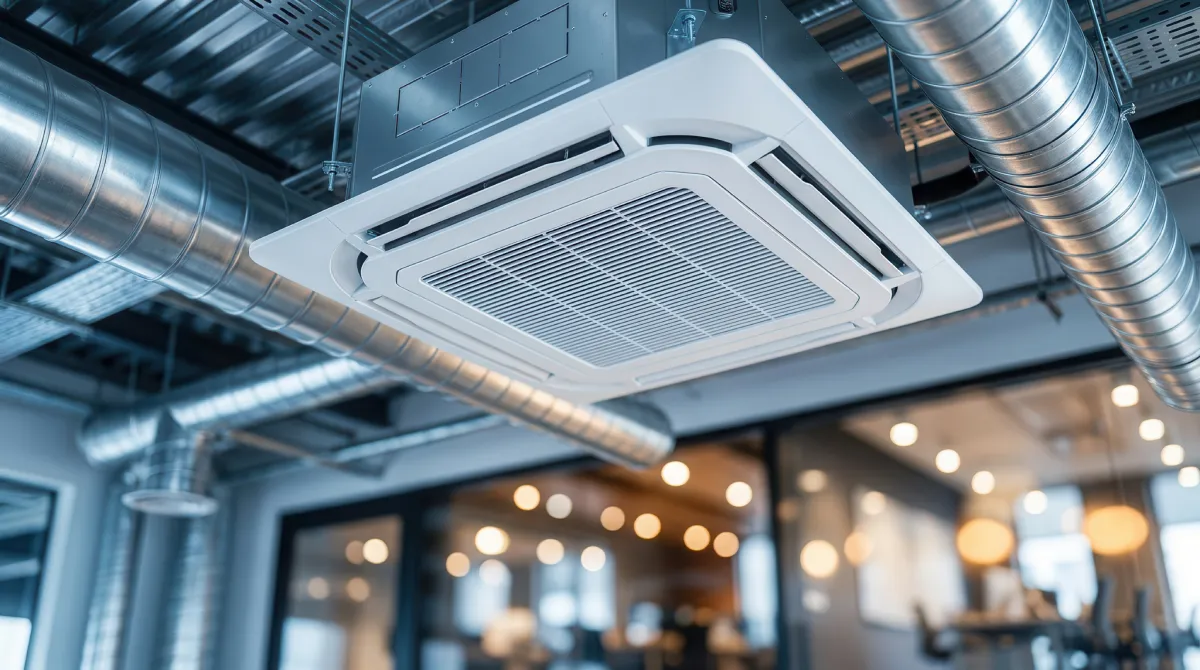
An effective HVAC control system can make a significant difference to how efficiently a commercial building operates. By coordinating heating, ventilation and air conditioning through intelligent building controls, businesses can reduce unnecessary energy consumption, improve occupant comfort and gain greater visibility over building performance.
However, achieving these benefits does not necessarily mean replacing existing equipment. Often, the greatest opportunities lie in reviewing how current systems are controlled, identifying inefficient operating routines and making targeted adjustments.
For building owners, facilities managers and mechanical and electrical contractors, understanding how building controls optimise HVAC performance is an important step towards improving efficiency and managing long-term operating costs.
What Is an HVAC Control System?
To understand how HVAC performance can be improved, it helps to consider how the different systems are managed.
An HVAC control system regulates the operation of heating, cooling and ventilation equipment to maintain suitable conditions within a building. It uses information from sensors, programmed settings and operating schedules to determine when equipment should run and how much heating, cooling or ventilation is required.
In commercial buildings, these functions are often coordinated through a Building Management System (BMS).
A BMS system in HVAC applications provides centralised monitoring and control of equipment such as boilers, heat pumps, chillers, air handling units, fans, pumps and associated valves and dampers.
Rather than allowing individual systems to operate independently, a BMS can coordinate their operation according to the building’s requirements.
For example, temperature sensors may indicate that a particular area requires additional heating. The BMS processes this information, checks the relevant operating conditions and adjusts the heating system accordingly.
Once the required temperature is achieved, the system can reduce its output rather than continuing to operate unnecessarily.
This relationship between sensors, control software and equipment response is fundamental to effective HVAC building management.
How Building Controls Improve HVAC Performance
With the basic control process established, the next consideration is how it can be used to improve day-to-day building performance.
Modern HVAC control systems can optimise several aspects of operation, helping equipment respond more accurately to changing building conditions.
Matching HVAC Output to Building Demand
One of the most important functions of an HVAC control system is matching equipment output to actual demand.
Building requirements change throughout the day. Occupancy levels fluctuate, external temperatures vary and different areas experience different heating and cooling loads.
Demand-led control allows the BMS to adjust equipment operation in response to these changes.
For example, a building may require substantial heating during a cold morning but considerably less once internal temperatures stabilise. Appropriate controls can reduce heating output as demand falls, avoiding unnecessary energy consumption.
This approach helps maintain comfortable conditions without operating equipment at a higher output than necessary.
Optimising HVAC Schedules and Start/Stop Times
Operating schedules are another common source of avoidable energy consumption.
Many commercial buildings have HVAC systems programmed to start at fixed times, regardless of weather conditions or actual occupancy requirements.
Time and temperature optimisation allows a BMS to calculate more appropriate start and stop times based on building conditions.
For instance, a well-insulated office may retain sufficient warmth overnight to require a later heating start on milder mornings.
Similarly, the system may be able to stop heating before the end of the working day while maintaining acceptable temperatures.
Correctly configured schedules help prevent equipment running unnecessarily before occupants arrive or after they leave.
Zoning and Occupancy-Based Control
Different areas of a building rarely have identical environmental requirements. Meeting rooms, offices, reception areas and communal spaces may have different occupancy patterns and temperature needs.
Zoning allows HVAC controls to manage these areas separately, where the installed system supports independent control. Occupancy sensors and programmed schedules can provide additional information about which areas are being used.
Consider an office building with meeting rooms that are occupied intermittently. Rather than maintaining full heating or cooling throughout the day, the BMS could adjust conditions according to scheduled or detected occupancy.
This reduces unnecessary conditioning of unoccupied spaces while maintaining suitable comfort when rooms are needed.
Weather Compensation
External weather conditions directly influence the heating and cooling requirements of commercial buildings. Weather compensation uses outdoor temperature information to adjust heating system settings automatically.
For example, when external temperatures rise, a weather-compensated heating system can reduce its heating water temperature where appropriate. This helps prevent excessive heating output and can improve the efficiency of compatible heating equipment.
Weather compensation is one of the software-based optimisation techniques that can be incorporated into suitable BMS applications.
Variable-Speed Control of Fans and Pumps
Fans and pumps do not always need to operate at full speed to meet building demand. Where equipment includes compatible variable-speed drives, the BMS can adjust motor speeds according to system requirements. For example, an air handling unit may reduce fan speed when ventilation demand decreases, provided minimum airflow requirements are maintained.
Similarly, pump speeds can be adjusted in response to heating or cooling distribution requirements. Reducing unnecessary motor operation can improve HVAC energy efficiency while helping equipment respond more precisely to demand.
Demand-Controlled Ventilation
Ventilation is essential for maintaining suitable indoor air quality, but excessive ventilation can waste energy. Demand-controlled ventilation adjusts airflow according to actual requirements, using inputs such as occupancy information or carbon dioxide (CO₂) measurements.
In a conference room, for example, ventilation demand may increase significantly when the room becomes fully occupied. Once occupants leave, the BMS can reduce ventilation rates to an appropriate minimum rather than continuing at maximum output.
This approach can reduce fan energy consumption and the energy needed to heat or cool incoming air, while maintaining required ventilation standards.
Preventing Simultaneous Heating and Cooling
One particularly inefficient operating condition occurs when heating and cooling systems work against each other. This can happen when control settings are poorly coordinated or temperature setpoints overlap. For example, a cooling system may attempt to lower room temperature while a heating system simultaneously works to raise it.
Appropriate BMS HVAC controls can introduce control deadbands, operating sequences and interlocks to prevent unnecessary simultaneous operation. These measures help reduce wasted energy without compromising required environmental conditions.
Coordinating HVAC Plant and Systems
Individual control improvements become more effective when equipment operates as a coordinated system.
An HVAC BMS control system can manage the sequence in which boilers, chillers, pumps and air handling equipment operate. For example, the BMS can enable heating plant when there is a genuine demand and coordinate associated pumps and valves. It can also manage duty rotation between suitable items of equipment, helping distribute operating hours and support reliability.
The result is a more integrated approach to HVAC management, rather than multiple systems operating without effective coordination.
How HVAC Monitoring Identifies Inefficiencies
Effective control is only part of the process. Understanding how equipment actually performs is equally important.
HVAC monitoring provides facilities teams with information about operating conditions, equipment behaviour and potential inefficiencies. A properly configured BMS can collect and display data from connected equipment, including temperatures, operating states, setpoints, alarms and running hours.
Historical trend data allows engineers to examine performance over time rather than relying solely on current readings. This is particularly useful when identifying problems that are not immediately obvious during a site visit.
Using Trend Data to Identify Inefficient Operation
Consider a commercial building where energy consumption remains high despite relatively low occupancy. Reviewing BMS trend data might reveal that an air handling unit continues operating late into the evening. Further investigation could identify an outdated schedule that has not been amended since the building’s working arrangements changed. Correcting the schedule may reduce unnecessary running hours without requiring replacement equipment.
Other common issues revealed through HVAC monitoring include:
- Heating or cooling equipment operating outside occupied hours
- Temperature setpoints that no longer reflect building requirements
- Fans or pumps running continuously despite reduced demand
- Heating and cooling systems operating simultaneously
- Control valves or sensors behaving unexpectedly
- Equipment failing to respond correctly to programmed control sequences
Alarms can also alert building operators to abnormal conditions, allowing faults to be investigated before they develop into more serious operational problems. However, monitoring is only valuable when the information is reviewed and acted upon. Regular analysis helps turn building data into practical operational insights.
How HVAC Control Systems Improve Energy Efficiency
Once inefficient operation has been identified, building controls provide opportunities to reduce unnecessary energy consumption. HVAC energy efficiency depends on several factors, including equipment condition, system design, building characteristics and control strategy. Even efficient equipment can consume excessive energy if it operates for longer than necessary or responds poorly to changing demand.
Building management system HVAC controls help address this by ensuring equipment operates when required and at an appropriate output. The main opportunities typically involve reducing operating hours, avoiding excessive heating or cooling, coordinating plant operation and improving control accuracy.
For example, adjusting the temperature setpoint of a heating system may reduce energy consumption where the original setting was unnecessarily high. However, changes must also account for occupant comfort, equipment requirements and the building’s intended use.
The objective is not simply to minimise HVAC operation. It is to deliver the required indoor conditions as efficiently as possible. A structured business energy assessment can help identify where control improvements may deliver worthwhile operational benefits.
Importantly, the potential savings will vary between buildings. Existing control arrangements, equipment condition, occupancy patterns and current energy consumption all influence the outcome. Establishing a baseline and reviewing performance after adjustments allows improvements to be assessed using actual operating data.
Can Existing HVAC Systems Be Optimised Through Building Controls?
For many businesses, improving HVAC performance begins with the systems they already have. A common misconception is that meaningful HVAC optimisation always requires new equipment. In practice, this is often not the case.
At Cube Controls, optimisation starts with reviewing existing BMS software, settings and control routines, including on older systems. Our experience regularly highlights settings and operating sequences introduced years earlier that no longer reflect how a building is being used.
A building that previously operated from 8am until 6pm, for example, may now have flexible working arrangements and significantly different occupancy patterns. If the HVAC system still follows its original schedules, energy may be consumed conditioning areas that are largely unoccupied.
Reviewing and amending the control software can address these issues without necessarily replacing the heating, cooling or ventilation equipment.
Controls Upgrades and System Integration
Where existing controls cannot support the required functionality, targeted upgrades may be appropriate. These could involve replacing outdated controllers, introducing additional sensors or integrating compatible equipment into an existing BMS.
Cube Controls works across multiple BMS platforms and can develop solutions that incorporate existing equipment where technically practical. Our BMS installation and modification services support businesses looking to improve control functionality without automatically committing to a complete system replacement.
Recommissioning and System Validation
Even a well-designed control system can lose effectiveness when building requirements change or settings are altered over time. Recommissioning involves reviewing and adjusting system operation to ensure controls continue performing as intended. This may include checking sensors, reviewing control sequences, confirming operating schedules and testing equipment responses.
Professional BMS validation helps establish whether the system is functioning correctly and whether further improvements are required. These activities can provide a practical starting point for improving HVAC performance before considering substantial capital investment.
Why Ongoing HVAC Optimisation Matters
Initial improvements are valuable, but maintaining efficient HVAC operation requires continued attention. Commercial buildings are rarely static environments. Occupancy patterns, internal layouts, equipment and operating requirements can all change. Without regular review, control settings that were once appropriate may gradually become inefficient.
At Cube Controls, reviewing BMS effectiveness forms part of our routine servicing approach. During maintenance visits, we assess how systems are operating and advise clients where improvements could be made. This includes reviewing time and temperature settings, demand-led control strategies and occupancy-based operation where applicable. Ongoing HVAC optimisation also helps identify developing faults, maintain reliable equipment operation and support consistent occupant comfort.
For building owners and facilities managers, working with a knowledgeable BMS specialist means having access to practical advice about both current system performance and future improvement opportunities. Regular BMS maintenance provides an opportunity to review these issues systematically rather than waiting for rising energy costs or comfort complaints to reveal a problem.
Optimise HVAC Performance with Cube Controls
An effective HVAC control system does more than switch equipment on and off. It coordinates heating, cooling and ventilation, responds to building demand and provides the information needed to maintain efficient operation.
From improved scheduling and zoning to demand-controlled ventilation and ongoing HVAC monitoring, building controls offer practical opportunities to reduce unnecessary energy consumption while supporting occupant comfort. Crucially, these improvements do not always require new equipment.
Reviewing existing software, correcting outdated routines and validating system performance can often provide a sensible starting point. At Cube Controls, we design, install, modify and maintain Building Management Systems for commercial buildings across the UK. Our approach focuses on understanding how each building operates and identifying practical opportunities to improve control, efficiency and reliability.
Whether you are planning a new HVAC building management system or looking to improve the performance of existing controls, our experienced team can provide informed, practical advice. Contact Cube Controls to discuss your HVAC control system and find out how we can help optimise your building’s performance.